
CougarMarks.com home
The photos discussed in An Illustrated Guide to Cougar Marks on Arbutus and Cedar Trees can be found in the PHOTOS section.
An Illustrated Guide to Cougar Marks on Arbutus and Cedar Trees
The cougar Works a Powerful Magic on the human imagination. – Robert Redford
Introduction
This illustrated guide is an adjunct to the paper, Apparent Cougar Claw Marks on Arbutus Trees because the seemingly endless variety of cougar marks found on Southern Vancouver Island is more than my above mentioned paper can cover. The following cougar marks in each category are arranged in approximate order of age of the tree injury. When cougar claws cut into an arbutus tree, the animal must exert a significant amount of force to cut the injury, especially an injury of three or four wounds. That exertion is mitigated when their claws are tightly bunched, leaving a narrow and sometimes deep arboreal mark. It is doubtful that an animal smaller and weaker than a cougar could cut the discussed injuries on arbutus trees found in this area.
In general, sites where the author has found the most arbutus trees marked by cougars are where the tree is on reasonably level ground, where the trunk is free from interfering brush, branches, logs and other trees, however there are exceptions to that generalization. Marks can be found on live arbutus trees lying on or near the ground, yet they do not appear to contain more than an average number of marks found on standing arbutus trees. The author has seen less than a dozen Western redcedar trees with cougar rakes, one cougar rake on a species of willow tree but has found no cougar marks on Douglas fir or Grand fir trees nor on a Red alder or any, unlike many sightings in the US Southwest, cougar marks on both dead trees or logs.
Shallow Claw Marks
Shallow claw marks may widen as in photos 3304 and 0814 yet many may remain a concavity as they age; photo 3333 while others can simply fill in without a permanent raised scar, photo 4635. Photos 0317 and 3304 are the freshest while photo 3333 is a number of years old. In time, shallow marks will be hard to recognize as the tree grows and the marks become less distinct.
Photo 0642-A. This illustrates the same portion of the arbutus trunk that was pictured in Apparent Cougar Claw Marks on Arbutus Trees, Figure 1. The white lines in photo 0642-B show the coverage of the photo 0642-A and the height on the tree that the cougar climbed to. Photo 3456 is of the same area of the trunk shown in photo 0642-A, taken 1½ years later.
Shallow claw marks made by cougars on arbutus trees could be cut for stretching, claw maintenance or scent marking and conceivably, marks may also be used for visual communication such as when a feline is posting a claim to territory.(1).
Claw marks, such as in photos 0814, 3305 and 0620, though shallow, may be striking enough to be a communication signpost. The sloped trunk, photo 0620, between 1.2 m and 1.5 m off the ground is visually prominent in an open area where it could designate a cougar’s home territory. “(The cougar) patrolled his territory with diligence, using his claws to scratch cougar No Trespassing signs into tree trunks.”(2). “Mountain lions scratch downed logs and vertical trunks with their claws, and this may play the dual role of scent marking and shedding the outer layers of their claws to refine their edges.”(3). The tree wounds in photo 0620 appear uniform in their healing stage, suggesting they may be of the same age and may have been made by a resident cougar returning to confirm it’s home range over a short period of time. The alignment of many of the injuries on this trunk diverge from the axis, suggesting a cougar was standing on the ground and stretching on this arbutus.
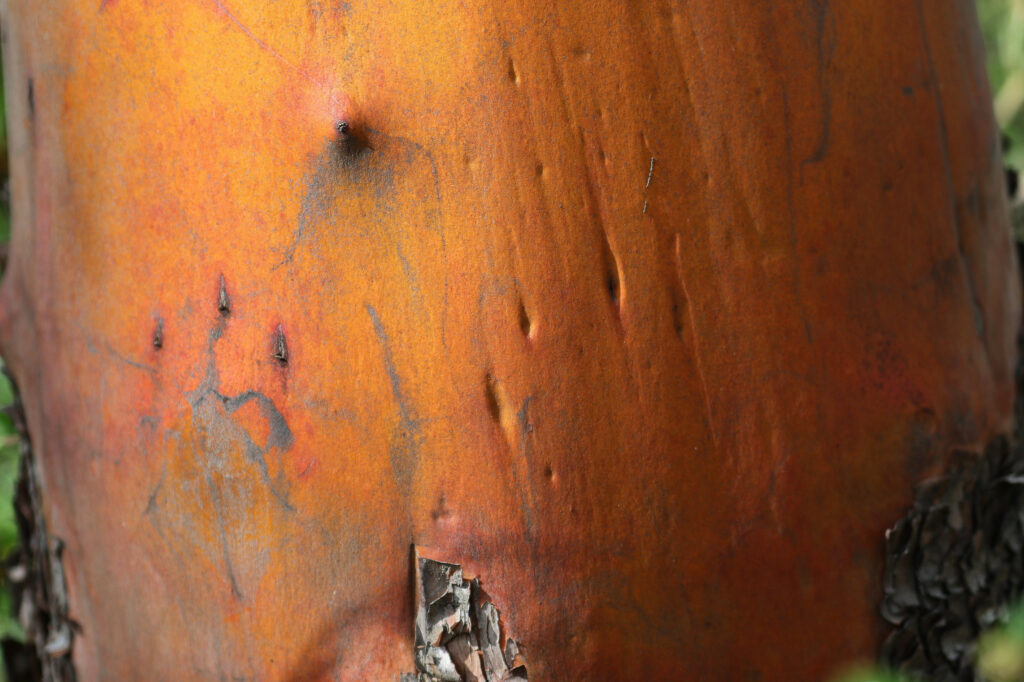
Deep Claw Marks.
Deep claw marks made by a cougar on arbutus trees, are normally tidy, however tear-outs found in this category of mark are to be expected due to the claws scraping the cambium. Though rough when fresh, the healed wounds will result in a raised but comparatively smooth convexity as in photos 0932 and 0034. Tearouts may be found in both fresh and nearly healed claw marks. Deep claw marks are notable for the variety of tree wound styles and the expected claw mark arc in many tree wounds may be absent as in photos 0823 and 0837. Deep and impressive claw marks, photo 3344, may indicate a strong cougar has made the marks which, as noted, can be a signpost communication to cougars warning other males to keep away or it can inform females that this is the territory of a male.
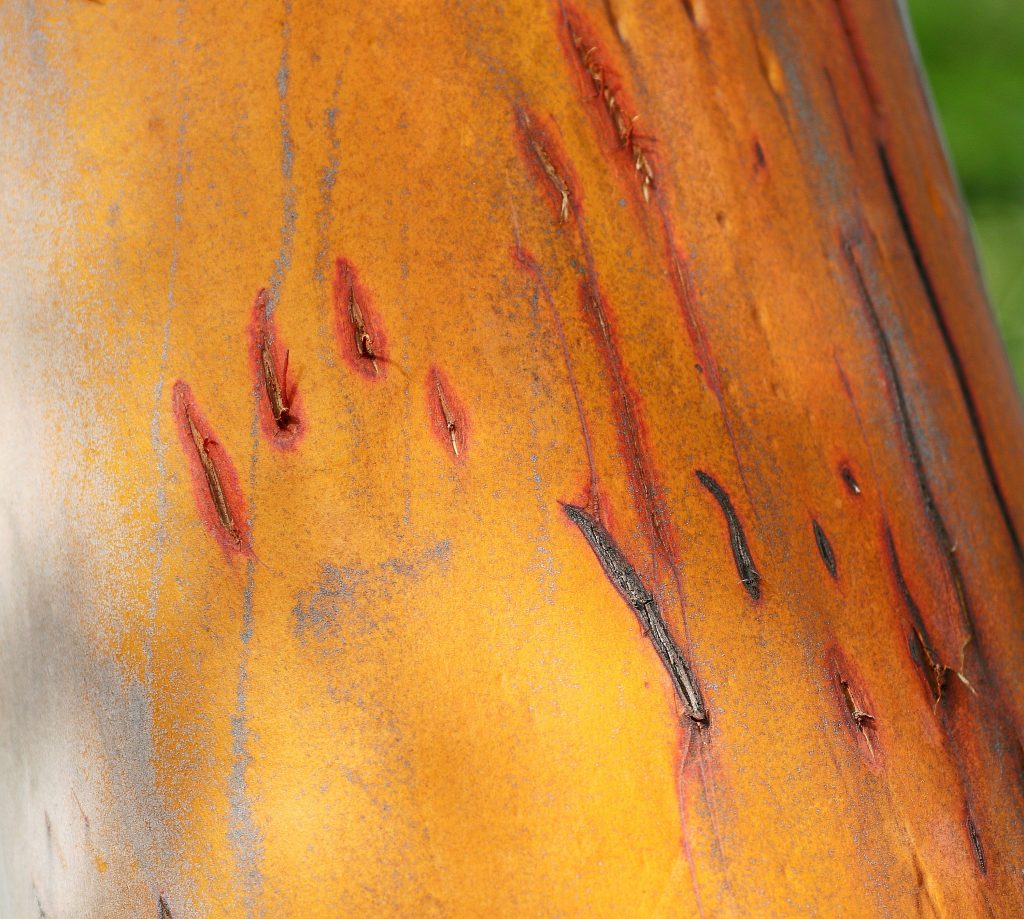
Front Paw Claw Rakes
A cougar’s front paw claw rakes can vary from short to long, from one injury to many and from shallow, minor wounds to large, deep injuries. Parallel cuts are common while most that the author has found are relatively tidy. Some of these examples of front paw claw rakes may have been cut with cougars’ broken claws. The large rake, photo 4964 is near a trail where animals would likely see it, yet many hikers have walked by this rake weekly without noticing it.
A claw rake may be bold enough to identify territory. At centre of photo 0317 the front paw claw rake is a set of four vertical marks yet it is an example of cuts to varying lengths, curves in opposite directions and convergences, illustrating a cougar’s paw flexibility. There are also two sets of three claw marks close by and several injury isolates in the same area of the trunk.
Photo 0771 illustrates a deep, four injury claw rake.The two centre injuries have healed and will remain as smooth, convex scars. The two outside wounds are still in the process of healing, suggesting they were cut deeper than the ones that are completely healed. The long, vertical scars above each mark indicate where portions of the rakes have healed while tear-outs show in the wound on the right.
For a number of years the author had looked out his window and seen the marks in photos 5479 and 5707 that begin begin at 6’ and extend to about 9’ but always dismissed this messy assortment of marks. It was thought that too many interfering branches made the tree wounds difficult to notice for it to have been made by a cougar. The marks were dissimilar to other claw patterns seen and well below these marks was a bark-free area of the trunk with no interfering branches, and lastly, the tree was 12 feet from our front door. It wasn’t until a ladder was climbed that it was realized those marks could only have been made by one animal. These marks are an example of cuts made for claw maintenance and not for communication purposes.
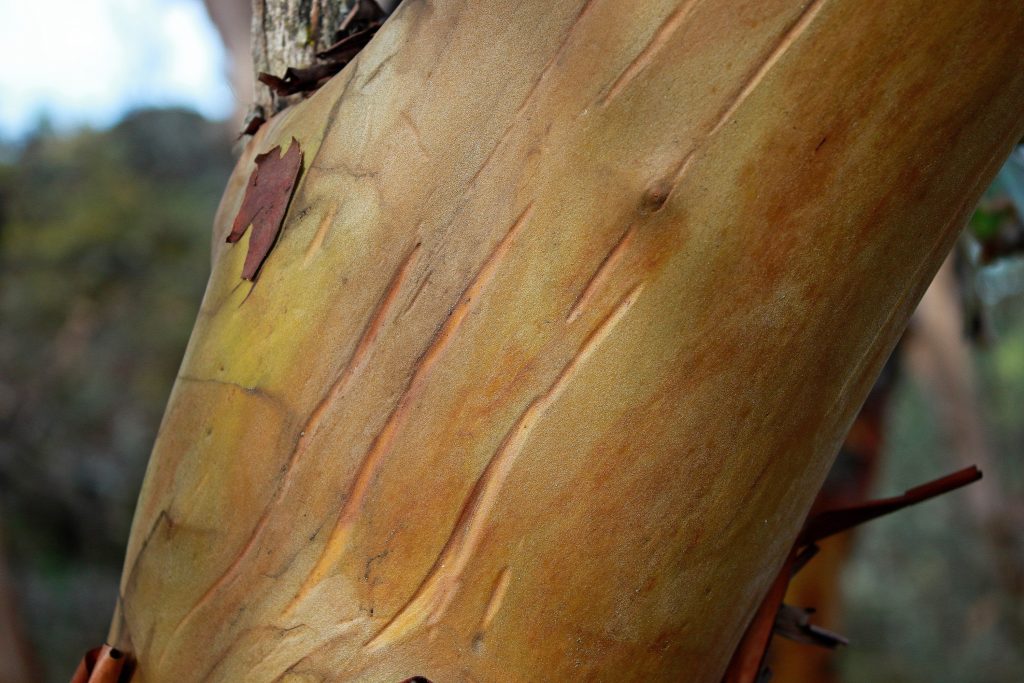
Hind Paw Claw Rakes
Hind paw claw rakes can look less like cougar marks than other tree injuries made by cougars and as a consequence, tend to be dismissed yet they have their own cougar-specific characteristics. Many hind paw claw rakes can be comparatively straight while occasionally others can exhibit a slight curve as in photo 4677. The healing characteristics of these injuries suggest that the marks appear to be overlaid over previous rakes but made at about the same time. In photo 4489, slanted hind paw claw rakes can be found across the trunk of an arbutus tree which contrasts with the tidy yet curved front paw claw rakes beside them.
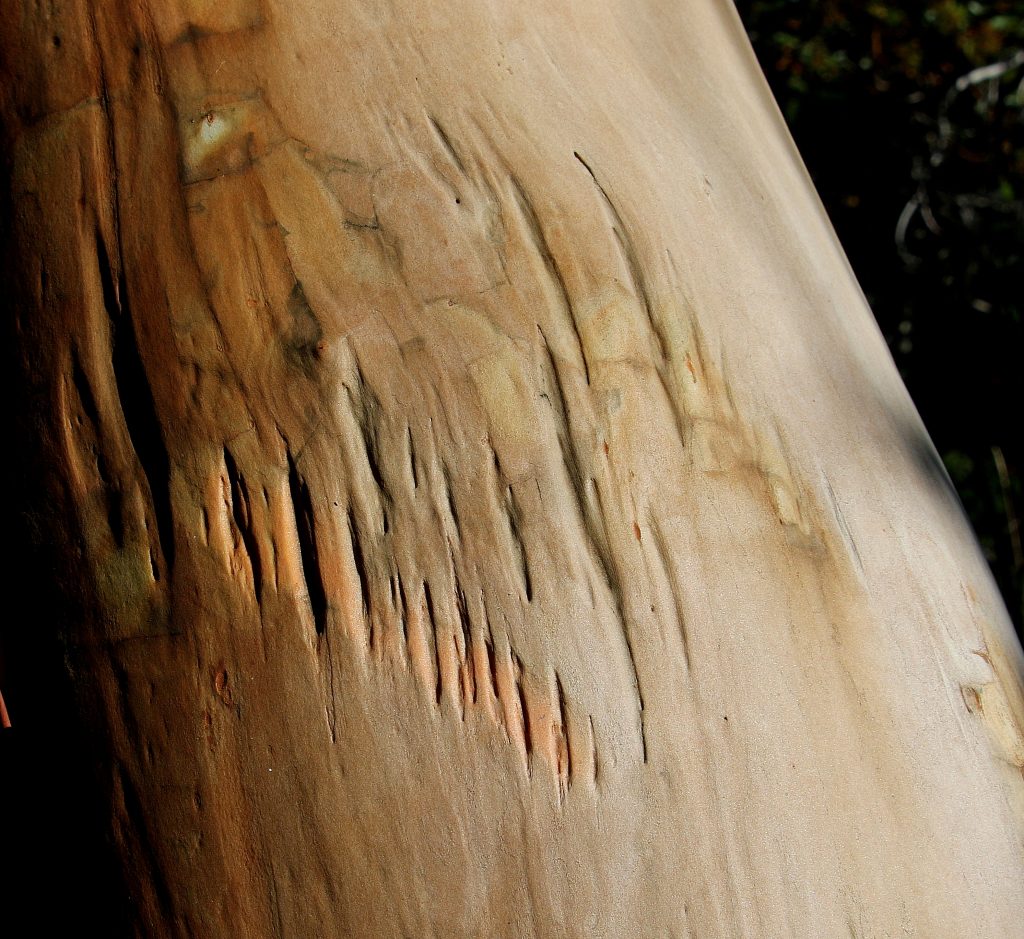
Claw Marks made by Broken Claws
Claw marks made by broken claws can vary in width depending on the thickness of the claw at the point of breakage. Photo 5292 illustrates the dissimilarity in wound widths as one claw rake overlays another rake, making it appear considerably broader. Similarly, the multitude of marks in photo 4640 were made by (a) cougars’ broken hind claws over earlier tree wounds. All other marks in this broken claw category were made by cougar’s front broken claws.
Miscellany
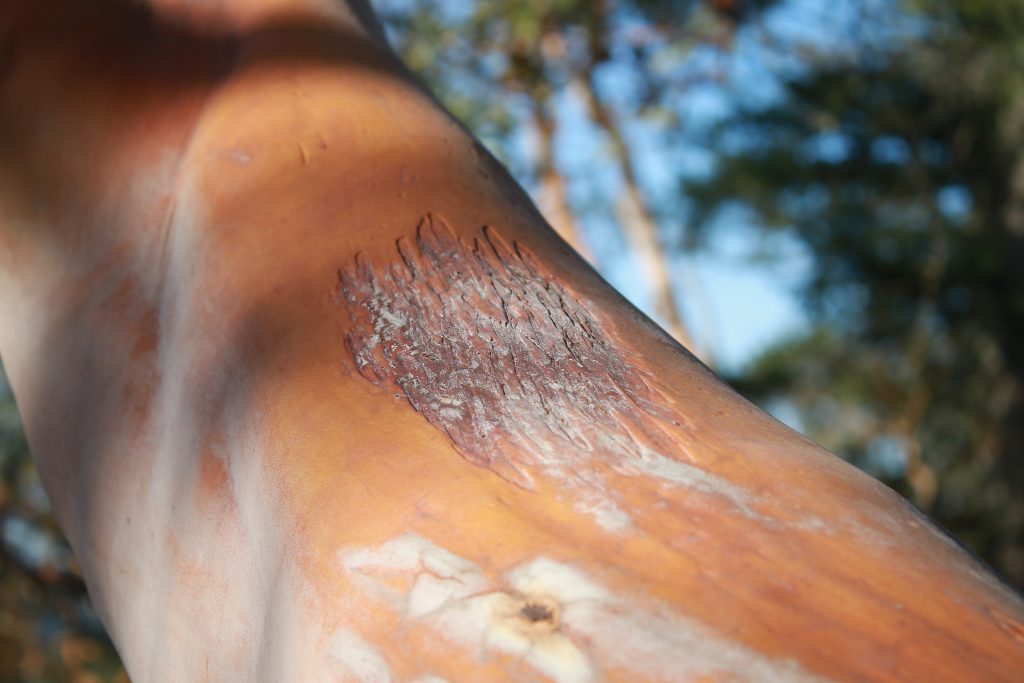
Cougar marks have been found in many diverse shapes, illustrating the flexibility of their paws thereby making them a challenge to identify. Photo 0212 is an assortment of shallow and deep cougar claw marks where the shallow marks have ‘filled-in’ flush with the surface of the arbutus trunk. If there are numerous cougar marks in the vicinity of an unidentified mark those wounds may, but not always, help to explain the origin of that mark.
In photo 0376 there are seven reasonably fresh tree injuries, made by a cougar or cougars that comprises two separate cougar claw marks. The lowest wound indicates a dew claw was pulled horizontally while four claw marks are aligned along the axis of the tree trunk. The two injuries on the left may be a separate mark as they appear rougher than the four marks. Because these marks were comparatively fresh when photographed, there is little indication of healing.
Photos 5267 and 5269 are of an uncommon mark of a cougar descending the arbutus trunk head first. “At the sound of my voice, the mountain lion, much to my surprise, started a headfirst descent, ratcheting his way down one side of the tree as I instinctively shinnied up the other side to avoid being being bumped into falling. There he goes! I yelled as the cougar scratched halfway down the tree trunk before gracefully propelling himself through the air. He landed on all fours in the snow and ran.”(4).
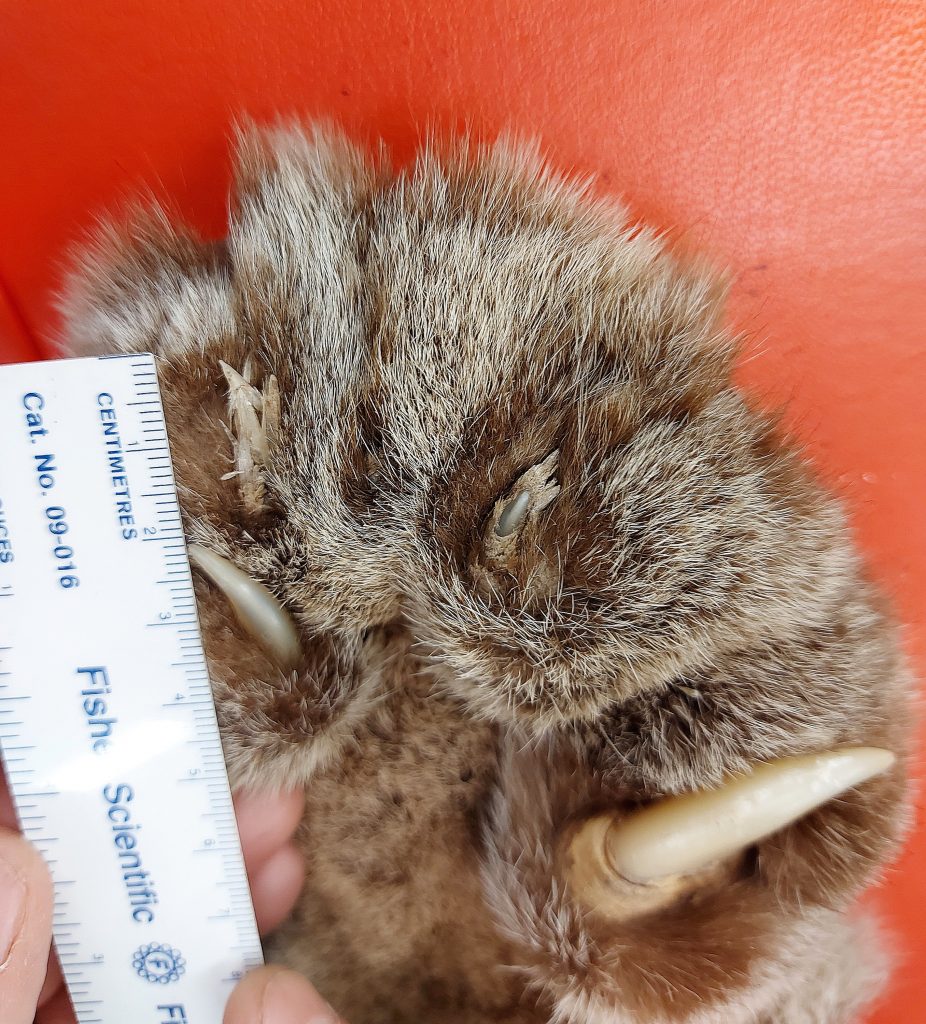
Composite photo. The fresh arboreal claw injury is from a cougars’ left front paw while the complete mark is 4 cm wide, approximately one half the width of a man’s hand. The overlay paw photo is used with permission of Florida Fish and Wildlife under creative common license. Photo 1086 is of natural stress folds of an arbutus tree while photos 83954 and 85038 illustrate broken cougar claws at the Royal BC Museum, Victoria; pelts 1477 and 6752.
Photo 0823 illustrates deep cougar claw marks in different stages of healing, are likely because of different depths of claw penetration. Such seemingly unlikely configurations may be puzzling at times, however it illustrates once again the flexibility of a cougar’s paw and claw combination.
Cougar Claw Marks on Cedar Trees
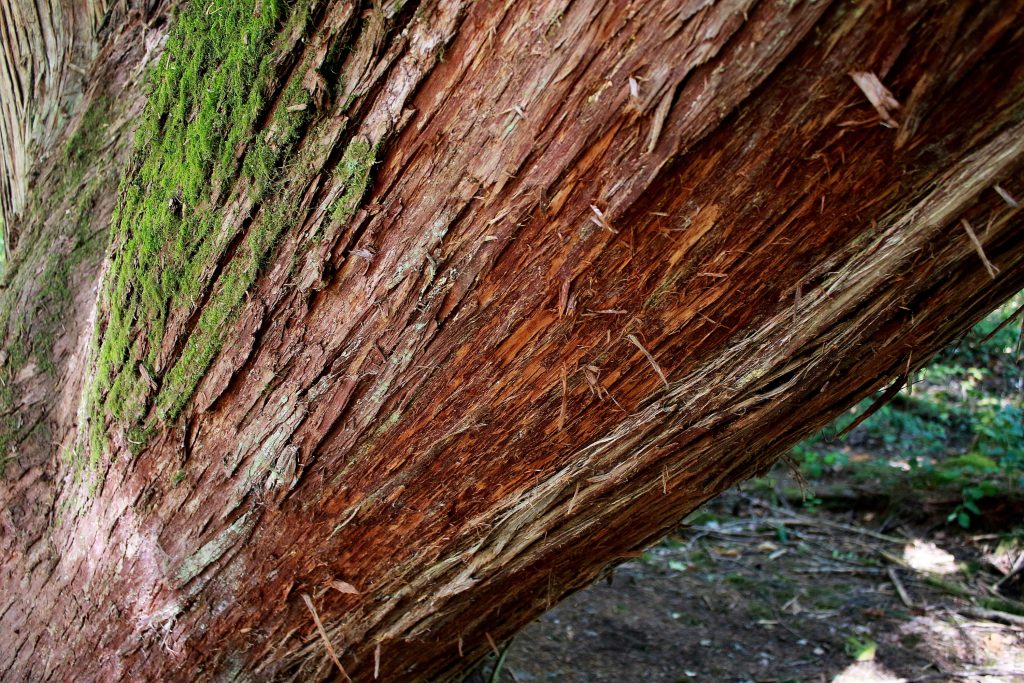
There are cedar trees in this area that show signs of claw marks yet there are differences between rakes made by adult cougars and those made by raccoons. Cougars can leave two corridors of significant bark tearout on cedar tree trunks, photos 5151, 5153 and 1017, with the space between less densely marked. The strands of cedar bark pulled partially out from the tree by cougar claws are significantly larger than those strands torn by raccoons. Cougar claw rakes can begin at 4 to 6 feet above ground level while raccoon and domestic cat marks will begin at roughly 2 to 3 feet. The exceptions are cougars’ hind claw marks which can begin at ground level. See photo 1017.
Interesting Tree Injuries
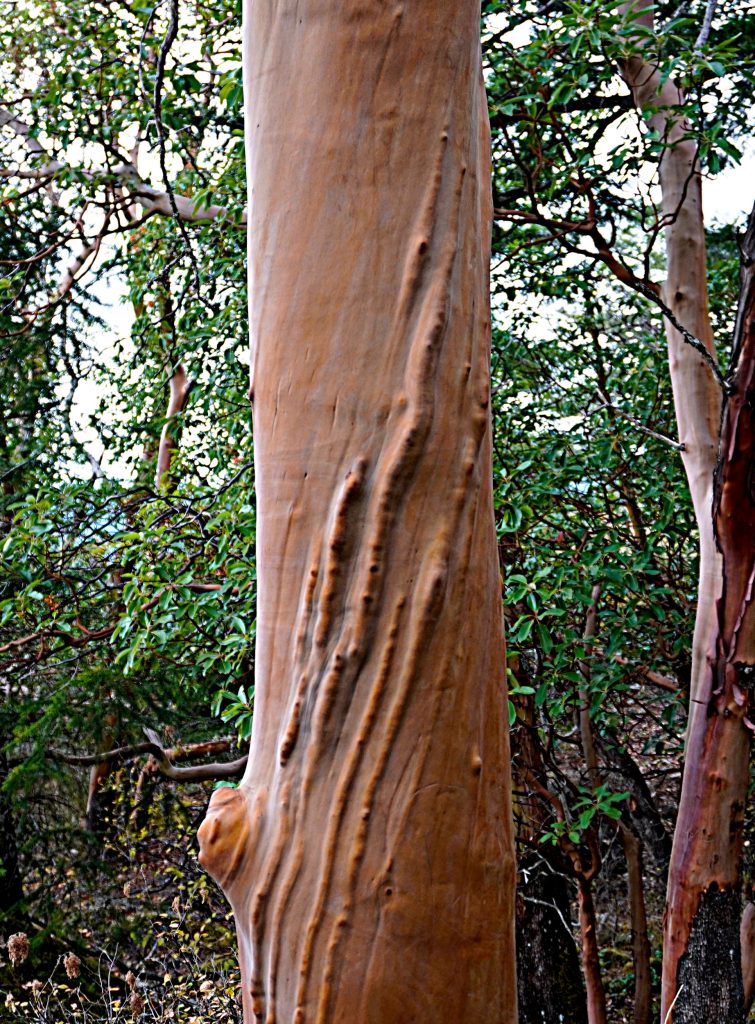
It is difficult to say what made the individual tree injuries in this category. In one image, there are signs that indicate the marks were made by both humans and a cougar/cougars.
Several others I think, were made by cougars. It is again worth quoting Dr. Mark Elbroch, a most highly respected cougar researcher; “Articulating evidence is an essential skill of the tracker. We must also use our imagination to interpret the signs we’ve discovered.”
1 and 2) Hornocker, Maurice. Cougars on the Cliff: One Man’s Pioneering Quest to Understand the Mythical Mountain Lion-a Memoir. 2023. Lyons Press. p. 272.
3). Elbroch, Mark. Mammal Track and Sign: A guide to North American Species. 2 nd. ed. 2019. Oxford University Press. p. 451.
4) .Hornocker, Maurice. Cougars on the Cliff: One Man’s Pioneering Quest to Understand the Mythical Mountain Lion-a Memoir. 2023. Lyons Press. p. 27.